intro to personal finance, investing
hi there! :) excited? i love personal finance, but i am by no means an expert. but regardless, i shall do my best with what i know to provide an easy and warm intro to future-proofing your life financially and ensuring you don’t miss TOO much of the opportunities that only time and an early start gives.
risk and return
let’s talk investing! there’s a lot of different ways to save and invest, and they vary in two aspects: risk and return. risk can be simply defined as probability of losing on your investment, and return is typically just how much you gain or earn as a percentage of your investment. if one desires a higher investment return, they must, in 99% of cases, accept more risk. for example, if you keep your money in the bank, it’s typically the most risk-free. you don’t really gain much, especially if the money is not in a high-yield savings account (HYSA). but at the same time, you don’t stand a lose it, unless the bank goes ‘rupt’. even then, FDIC (the us government) typically steps in to protect insured deposits up to $250k, so it’s pretty risk-free. on the other hand, if you had invested it all on a stock, let’s say Enphase Energy (NASDAQ: ENPH), a booming solar energy tech company that looked unstoppable in 2022, you would be looking at almost a 90% loss at the time of writing. or if you invested in NVIDIA (NASDAQ: NVDA), you’d be up 10x on your investments. higher risk = higher reward
investing
but investing isn’t about picking the right stocks. it doesn’t have to be all luck and hope. you don’t HAVE to invest, of course, but something i read 6 years ago still stays top of mind: “investing is no longer a path to wealth, but rather a necessity for the middle class.” money devalues over time, and one of the greatest vehicles of money-making is the stock market. you don’t have to pick the right stocks, just invest in all of them! through total market funds, essentially a basket of the hundreds and thousands of the biggest companies, you’re just betting our general economy will be healthy. for example, looking simply at VT, which is Vanguard Total World Stock ETF, it has returned almost 12% on average in the last decade. $10,000 invested in 2016 would be worth ~$30,000 today. rather than betting your hard-earned dollars on a single or a few companies, which you can totally do at your own risk, you can just bet on the US market or even just the world market at large with VT. this is called index fund investing—it’s very accessible and takes less than 15 minutes to set up. see more here (in-progress).
how/where to start?
do i go on robinhood and just buy something, like VT? well yes, that works. but there’s rungs on this investing ladder, specifically there are different accounts in which you can invest within; some provide very important benefits with taxes and returns that you must take advantage of first. here’s the order i’d suggest (but read this for a more comprehensive guide):
- 401(k) match
- if your employer offers you a 401(k) match, it’s free money on the table. a 401(k), in short, is a retirement account provided by most employers. it’s a “retirement” account because it provides large tax advantages if you agree on not withdrawing money until retirement age of around 59.5. there are certain situations in which you can withdraw early, so don’t worry. see here (in-progress).
- depending on the 401(k) plan, you’d be getting some sort of % match. for example, a 100% match up to 6% of your salary. that’s literally part of your compensation, so not taking advantage of it is letting your employer keep your hard-earned money. to enroll in it, just opt-in to your 401(k) and designate at least the match percentage of each paycheck to it. assuming the match policy above, you’d want to contribute 6% of each paycheck to your 401(k), and your employer will double that contribution each time!
- what’s so good about a 401(k) besides the match?? read bullet #3!
- Roth IRA
- so, this is still a retirement account, but it’s a personal one, rather than tied to employment/employer. anybody can open one! the only constraint is: you need to have earned income w/in IRS’s annual limit of ~$165,000 if filing single or ~$246,000 if filing jointly at the time of writing. so you need to have legal, documented, and taxed income haha.
- once you meet that requirement, you’re good to go, and boy is this a phenomenal investment account. here’s why (inspired from Fidelity):
- money will grow tax-free, withdrawals are also tax-free! you use post-tax money (which is money already on hand/in your bank/etc.) to contribute to Roth IRA; that’s the only tax part of it, rest is tax-free!
- there are no required minimum distributions (meaning you’re not forced to withdraw a certain amount after a certain age unlike 401(k)s, etc. which is helpful to more intentionally plan your taxable income amount in later years)
- you can ALWAYS withdraw your contributions at any time! other retirement accounts like 401(k) may have penalties for withdrawal early outside a qualified event, like a first home purchase.
- because it’s so tax-advantaged and flexible, the government sets a limit to how much you can contribute. for 2026, it is $7,500! that’s why you want to maximize your contribution to this every year that you can. the tax benefits are insane.
- here’s Fidelity’s more comprehensive explanation of a Roth IRA!
- 401(k)
- so, there’s two types of 401(k) usually: Roth vs Traditional. a Roth 401(k), like a Roth IRA, takes post-tax money (so money after income tax, etc.) of your paycheck and invests it so that it grows tax-free! a Traditional 401(k) uses pre-tax money (takes it out of paycheck so you don’t pay taxes on that portion of your paycheck) and invests it, but taxes you on the capital gains (not your contribution, but only the gains) when you withdraw.
- you can decide what’s best for you! i contribute to both types because i want more tax flexibility in the future. traditional allows me to avoid some taxes today, and i plan on converting it to roth ira after leaving my employer and during low-income years (this is a bit more complex, you can read more here later (in-progress), but ignore for now)
- to make things simple for you, just do a traditional 401(k) first and you can always change your mind later! both options gives you tax breaks, just differently.
- HSA
- HSA, or a health savings account, is something i haven’t started yet. it’s another tax-advantaged account that is meant to pay for qualified medical expenses, including co-pays, dental care, contacts, and more! however, you NEED a HSA-eligible plan, aka a high-deductible health plan (HDHP) to have an HSA.
- it’s super tax-advantages, often referred to as triple tax-advantaged:
- firstly, it typically uses pre-tax contributions, which gives you a tax break on that part of your paycheck, similar to a traditional 401(k) contribution. however, it’s actually better in that it not only avoids income tax, but also the FICA tax (which is payroll tax for social security and medicare)!
- secondly, growth within the account is tax-free (except for a few states like new jersey and cali)!
- lastly, withdrawals for qualified medical expenses (which are pretty flexible and includes things like massage guns, wearable health devices, skincare, and much more) are tax-free! sephora even has a whole section for HSA-eligible products (over 170 products at time of writing)
- taxable brokerage
- then, the last place to park your investing money (of these options of course and to the best of my knowledge) would be a taxable brokerage. that just means no particular special investment account like a 401(k) or IRA, but rather your good old-fashioned brokerage account like on Robinhood, Charles Schwab, and also Fidelity/Vanguard, which typically houses a lot of retirement accounts too!
- the cons of a regular, taxable brokerage is just that there’s no tax advantages. no pre-tax contributions. no tax-free growth. no tax-free withdrawals. but hey! you’re only getting taxed on money earned anyways, not on contributions and not on losses (T.T), so tax isn’t necessarily a bad thing; it means you’re at least making some money haha.
okay, all that being said, one important note: just putting money into these accounts doesn’t mean you’re necessarily investing! you have to actually choose funds or stocks to invest in, and that goes back to the idea of index fund investing. a very common and easy index fund investing setup would be the Bogleheads' Three-Fund Portfolio, which uses three funds (hence the name): 1) a domestic total market fund, 2) an international total market fund, and 3) a bond total market fund. assuming you’re under 40, i’d skip the bond fund and just do a two-fund portfolio. as for the two funds, i would suggest 70% VTI (Vanguard Total Stock Market ETF) and 30% VXUS (Vanguard Total International Stock ETF). the former is a fund comprises of ~3,500+ U.S. companies with a low expense ratio of 0.03% and the latter comprises of over 8000+ companies with an expense ratio of 0.05%. of course, there are many other portfolios you can go with, but this is just a typical one with a balanced risk-return profile. you can definitely go safer by adding a bond fund or cash position, and you can go riskier by buying more concentrated funds like QQQ (tracks the NASDAQ 100, aka the 100 largest companies on the NASDAQ exchange) or even individual stocks!
that’s all for today! more to be written
galbitang 갈비탕 (beef short rib soup) [instant pot]
source/inspo: Korean Bapsang
yap over the holidays, gabi and i decided to buy a multicooker (an Instant Pot, colloquially) for funsies, mostly because i thought it’d make meals and prepping easier! in particular, we wanted to make broths and soups; thus, this became the first recipe we followed, and it was great!
ingredients (4 servings) we halved it for ourselves!
- 3 to 4 pounds beef short ribs
- 1 medium onion cut into halves
- 2 large scallions white parts
- 8 plump garlic cloves (or 1 whole bulb) If using bulb, cut into halves crosswise
- 3 thin ginger slices 1-inch rounds
- 2 tablespoons soup soy sauce
- salt and pepper
- 1 pound Korean radish cut into bite size pieces (about 1.5-inch square, ⅓ - inch thick)
- 3 ounces starch noodles dangmyeon, soaked in warm water for 30 minutes - optional
- 2 scallions, finely chopped garnish
steps
- first trim off any thick layer of surface fat on the ribs
- then, in a pot, rinse them in cold water a few times to remove surface blood + bone dust
- drain then fill the pot w/ enough water to cover the ribs, about 4 cups
- close the lid tightly, turn on manual + high pressure for 2 minutes, ensure pressure switch turned to “sealing/sealed”
- once done, discard the liquid (or save to use in the soup or future meals). strain to remove brown bits if you’re using it though! then, thoroughly rinse ribs and the pot clean.
- return ribs to pot, add the onion, garlic, ginger, and soup soy sauce. add about 10 cups of water (ensure it’s below max fill line). then close lid tightly and pressure cook ribs for 35-40 minutes depending on thickness. NPR 10 minutes.
- once done, remove ribs, remove aromatic veggies w/ strainer, skim off fat
- then, put ribs back in along w/ cut radishes. change instant pot setting to “saute” and boil until radish turns translucent (about 10 min after boiling)
- add optional noodles a couple minutes before turning instant pot off. we cooked the noodles separately
- salt and pepper to taste! skim off or use fat separator to remove remaining fat if served hot. or just chill soup and discard the solidified fat. garnish w/ chopped scallions to serve!
tips
- the strained cooking liquid in step 5 can make the soup taste more “beefy” if added back in!
- removing scum and fat early on helps keep the broth clear and clean
- a good soup soy sauce makes a big difference in the taste. you can also use light fish sauce or regular soy sauce, but the latter can make the soup very dark, so use small amount and season w/ salt
- gabi recommends to still soak the short ribs beforehand to reduce the fat/scum in the initial cooking, making it easier to clean and continue onwards!

finally took the time to setup my automatic after-tax 401(k) contributions + in-plan roth conversion; whew. spent some time re-researching for the 5th time whether to DCA or lump-sum my roth ira, but going to DCA because i’m just a wee scared investor and the opportunity cost will just be the price of mental sanity. other than that, added 5% to my growth tilt for 401(k), fixed up my FIRE spreadsheet to break apart roth and traditional IRA and 401(k), and calculated % of paycheck that I can afford to go to retirement LOL. benefits of having a sizable cash position i guess?? although cash mostly seems only king in a bear market.
LOT Polish 787-8 Business Class Review
This past Sunday, Gabi and I had the opportunity to ride business class on LOT Polish from Chicago to Krakow. They fly this route once weekly with the rest of the week to Warsaw.
I don’t believe there’s any other airline that flies direct from Chicago to Poland just yet, and I think the reason why LOT flies it is because Chicago boasts an impressive Polish and people with Polish ancestry population. It’s to the point where a 2023 study by the city found Polish to be the 4th most widely spoken language in Chicago behind English, Spanish, and Mandarin. What’s interesting is that the 1972 musical Grease had the majority of characters with Polish surnames based on real-life experiences in a Chicago high school, but subsequent productions and films have toned down the Chicago Polish influences.
Anyways, back to the flight, we’re flying non-revenue standby, so we didn’t have confirmed tickets yet. We needed to clear with the ticketing counter for standby boarding passes, then we’d have to go to the gate to clear for actual seats. The loads had looked good, and we had little issue with it all. Security check at ORD Terminal 5 was awful as it was around 9pm and the PreCheck/Clear lines were all closed. It went from 4 security lines to 1 combined one, and it took us 45 minutes to get through. Our standby passes had “Fast Track” but it was just for show haha. Good thing we had enough time. Once boarding almost finished, the gate agent issued us our confirmed boarding passes: 1A and 1B! Not only business class, but also sitting next to each other without having to explicitly ask! To be fair, the cabin was only 2/3rds full.
So, LOT Polish still has the common but outdated 2-2-2 business class layout. That means 33% of business class passengers do not have direct access to the aisle and would likely need to climb over or wake up a sleeping passenger to use the restroom or exit their seats. However, what’s nice about it is that it felt a lot more open and spacious. The seats seemed noticeable wider with more legroom, which Gabi enjoyed a lot. The lack of wifi was honestly a fresh change of pace; I’ve missed the forced disengagement from the digital world air travel used to have. However, this layout and older product definitely can invite more awkwardness if sitting with strangers due to the limited divider and shared middle tray. Some other cons was that the seats lacked accessible storage space with only the foot cabinet space (unreachable if secured with a seatbelt) and overhead bins as storage. The entertainment devices were also quite outdated, and we ended up not using them at all. There was also this annoying, bright green light that I could not understand having.
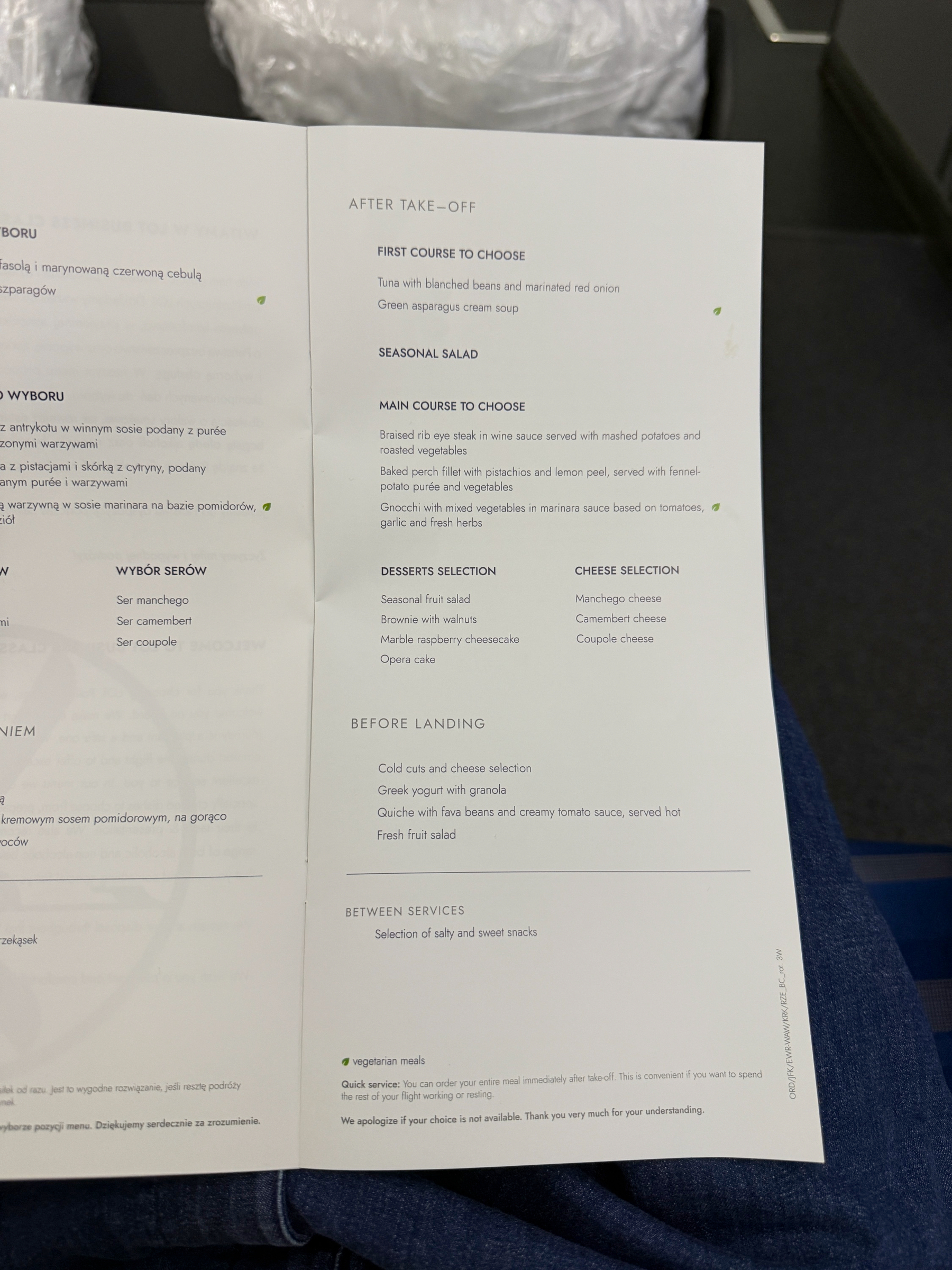
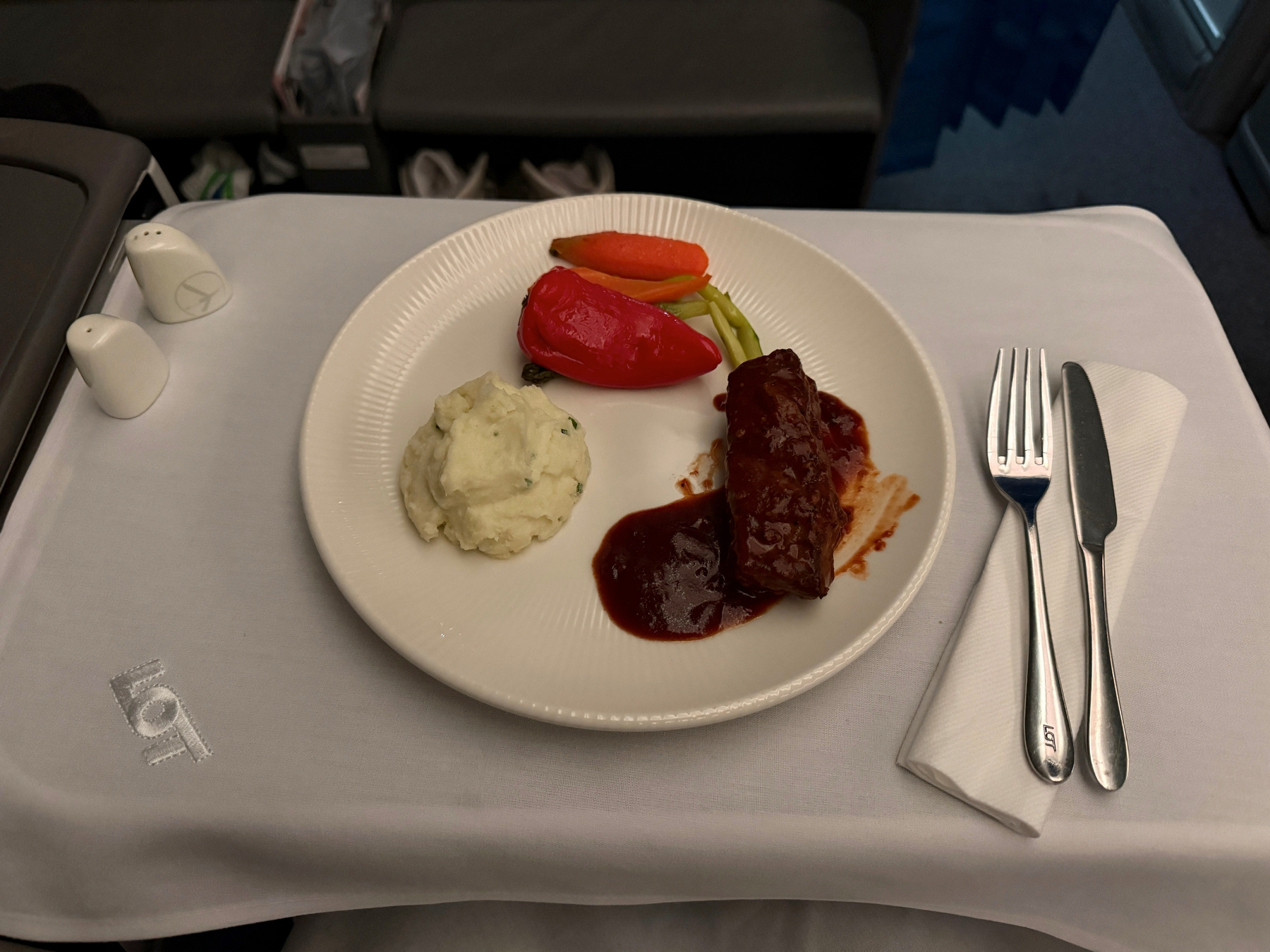
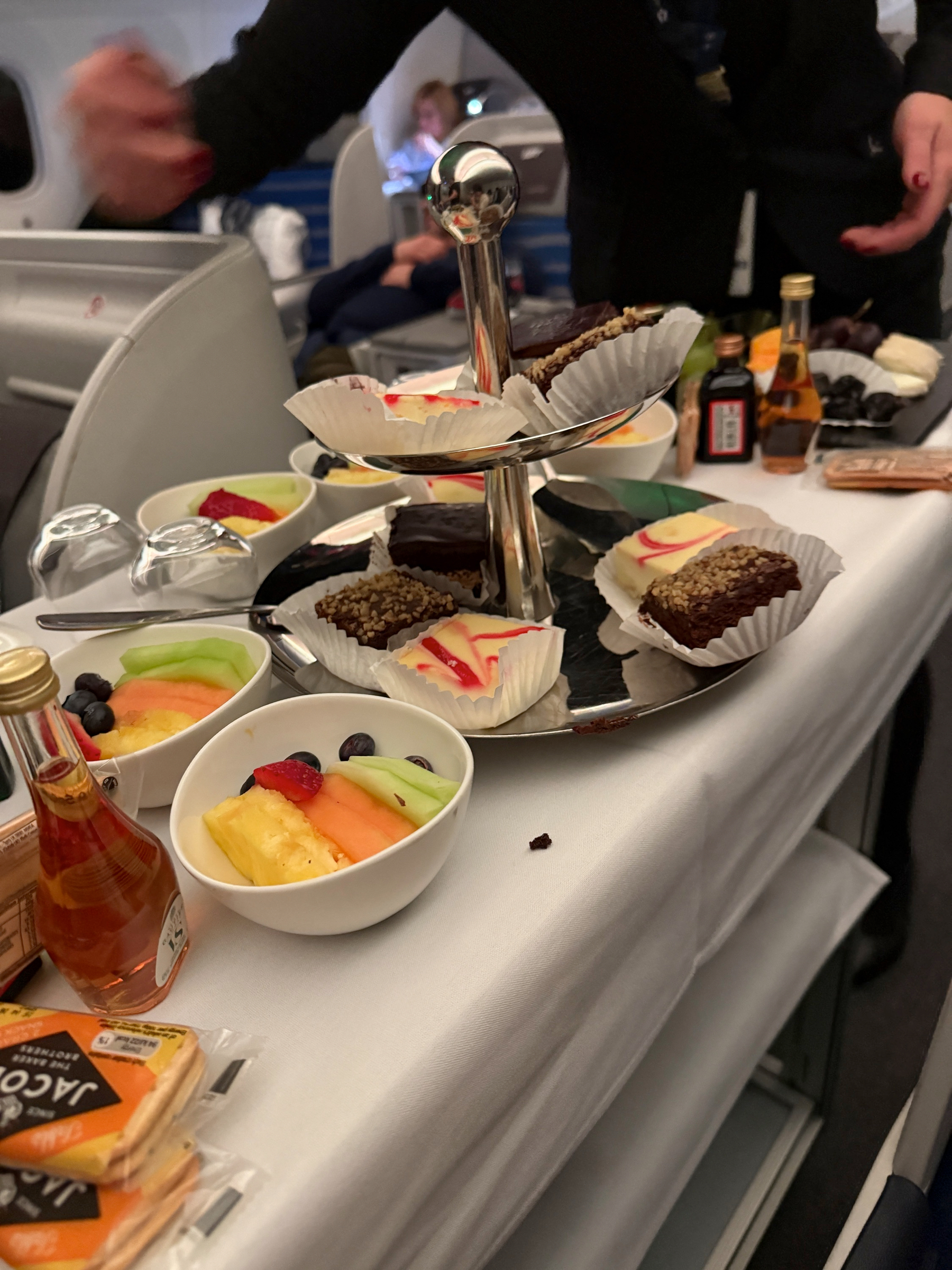
The food was pretty solid, though! That was a relief as we didn’t have dinner. For the appetizer, I chose the green asparagus cream soup, and I really enjoyed it! Baked rib eye with mashed potatoes and veggies was my main of choice. The meat was on the drier end, but only slightly, and it was overall well-seasoned and tasty. The drinks kept flowing non-stop—great Polish hospitality. Had mostly blackcurrant and orange juice haha, but I’m sure their wine selection was great. Tons of dessert options. Breakfast was also good. The cafe latte, though, tasted evidently like powdered espresso. I’m not sure how Turkish Airlines had such good espresso for their catering.
After dinner, we set the beds ourselves. I’m sure they would’ve helped if requested, but it honestly was pretty simple. The mattress cover was more for cleanliness than comfort—quite thin. Blanket—also quite thin—was enough comfort, although on the shorter side (not for me given average height). Pillow was solid. Gabi slept really well. I woke up a few times, mostly due to light coming from the gallery. I really should’ve used the nice eye mask I keep with me 24/7 or not have dropped the one they gave me. My fault. Overall, solid and roomy sleep experience.
At the end of the day, it was a relaxing and pleasant time. We had a great flight attendant taking care of us. She definitely helped elevate the experience, especially by stating that she was really happy to have had us as passengers (made my day). We all bonded over the cute Kodak Charmera we were taking photos with. Everyone was nice and helpful overall, too! It’s no Turkish Airlines in terms of hard and soft business class product, but it definitely was a memorable experience all the same.







Cities and Ambition — Paul Graham (2008)
Cities and Ambition ~3,600 words ~12 min read
alice sent me this, and it was an interesting read despite almost a decade passing since it was authored. i do see new york, sf, and berkeley reflect what he considered the messages of his time: focus on wealth, focus on power/prestige, and focus on living well. i would say that boston perhaps has not lived up to his expectations, but i also know nothing of boston really. what i suspect, though, is that intellectual production has shifted globally as the world adapted to a more digitally-connected world. many with ideas, creativity, and hunger for knowledge have been seemingly bypassing academia altogether and going straight into industry. chicago, where i am currently based, is interesting. it seems a bit more balanced and friendly. less comparison with one another and more focused on simply enjoying life? the conversations i’ve had here are much less clustered around wealth, prestige, and ambition, which has been a calm change of pace.
however, i’ve definitely not settled into the city yet to be comfortable saying too much about it. it’s been a bit hard to, especially as i knew very little people coming in. i also haven’t been intentional at all with it—mores o escaping abroad or spending time with my girlfriend in lieu of building a strong foundation in chicago. part of me also feels like my stay here is temporary, which makes me hesitant of planting and nurturing seeds in the city. but, i understand it is still all worth doing as relationships are the crux of life’s enjoyment. i just gotta set my mind to it and execute haha.

cat flyer for the apt!! qr code + address redacted for some sense of privacy LOL
fingers crossed we get a nice squad🤞

gabi and i just finished setting up our christmas tree that arrived early! accompanied by felt ornaments + knitted skirt! 🎄🎄🎄


fidelity or payroll should automatically stop 401k overcontributions 🙏🙏 the bare minimum please 😭😭 don’t let me down now
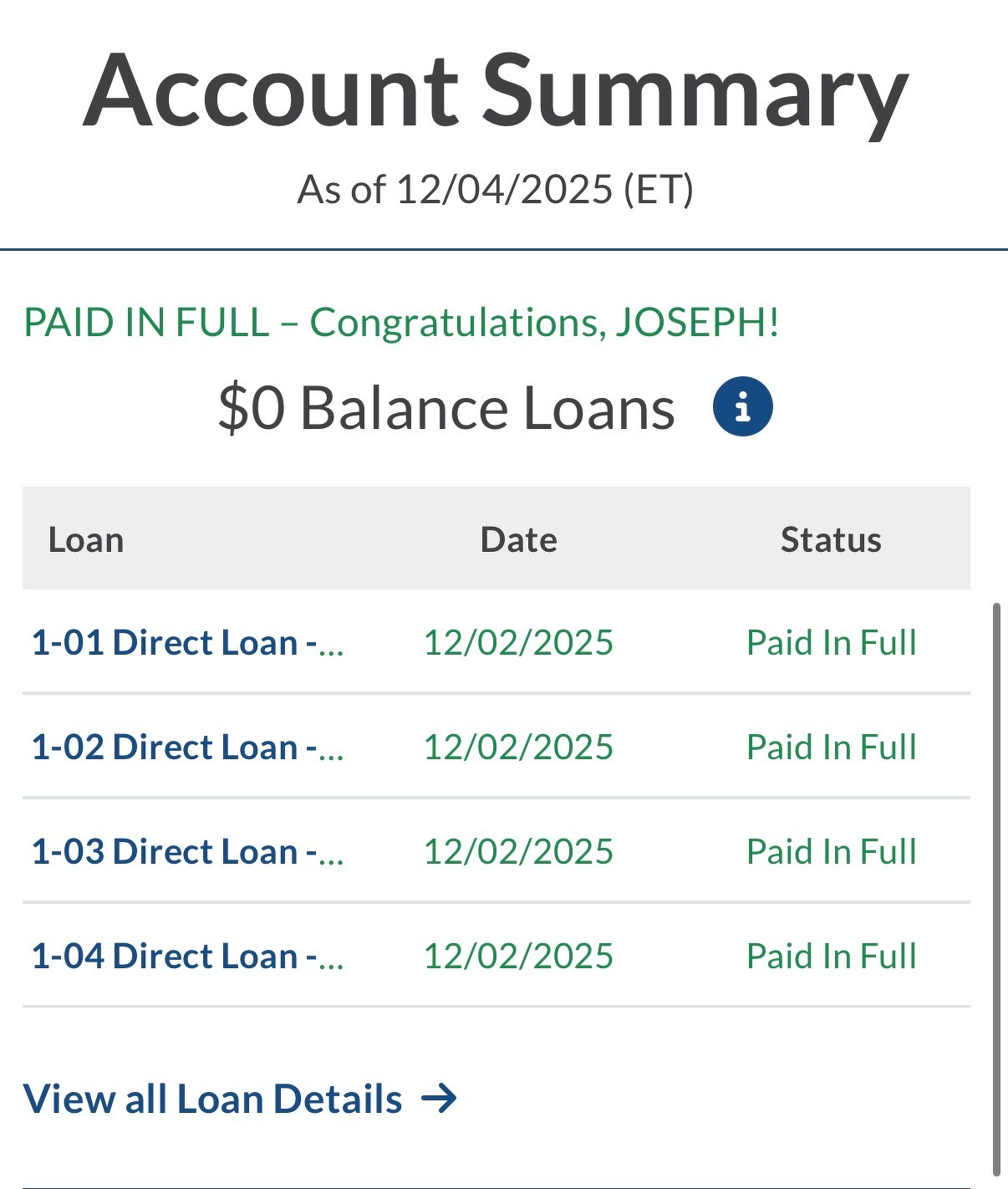
👋👋 byebye federally subsidized student loans, had a hard time letting you guys go for some odd reason
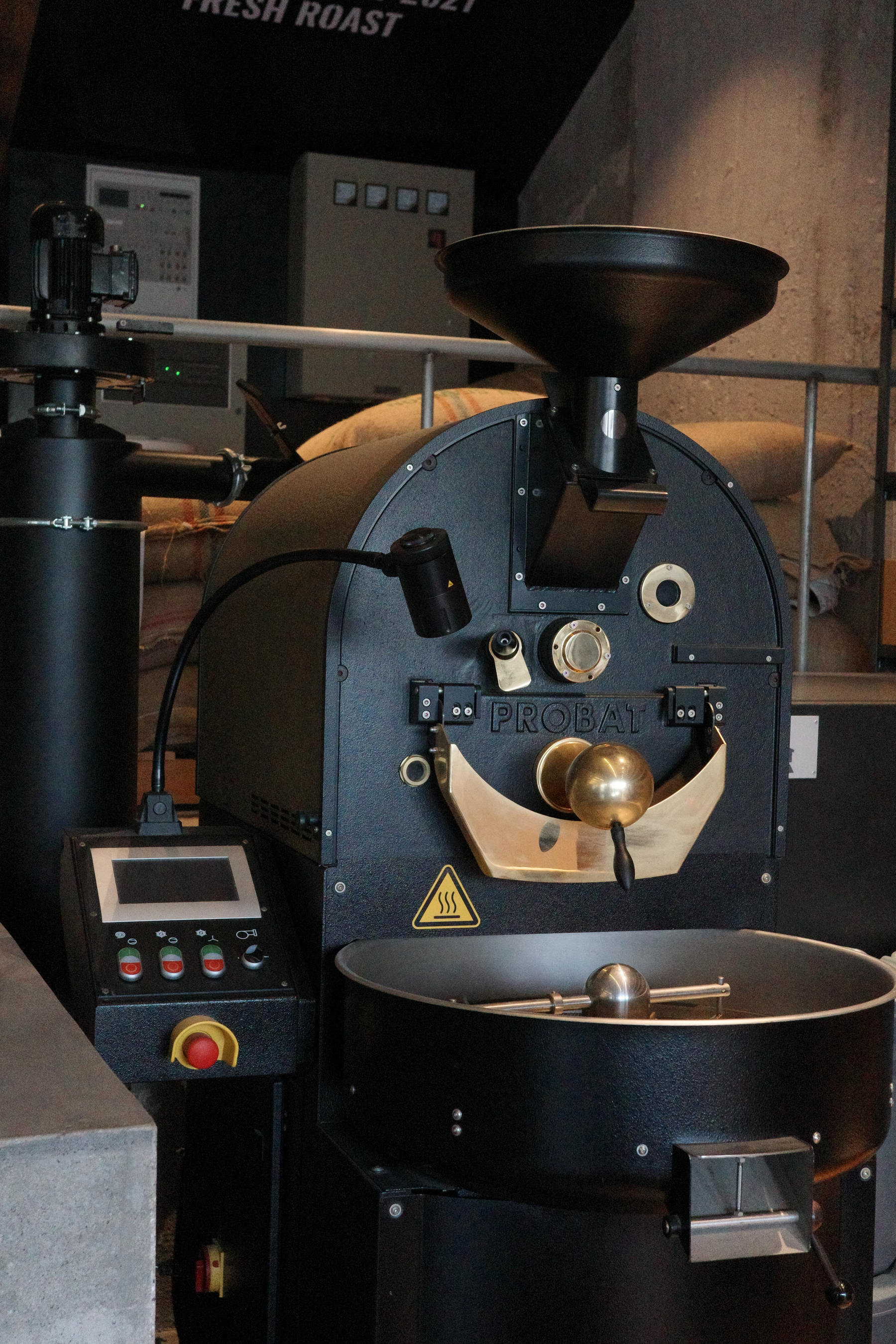
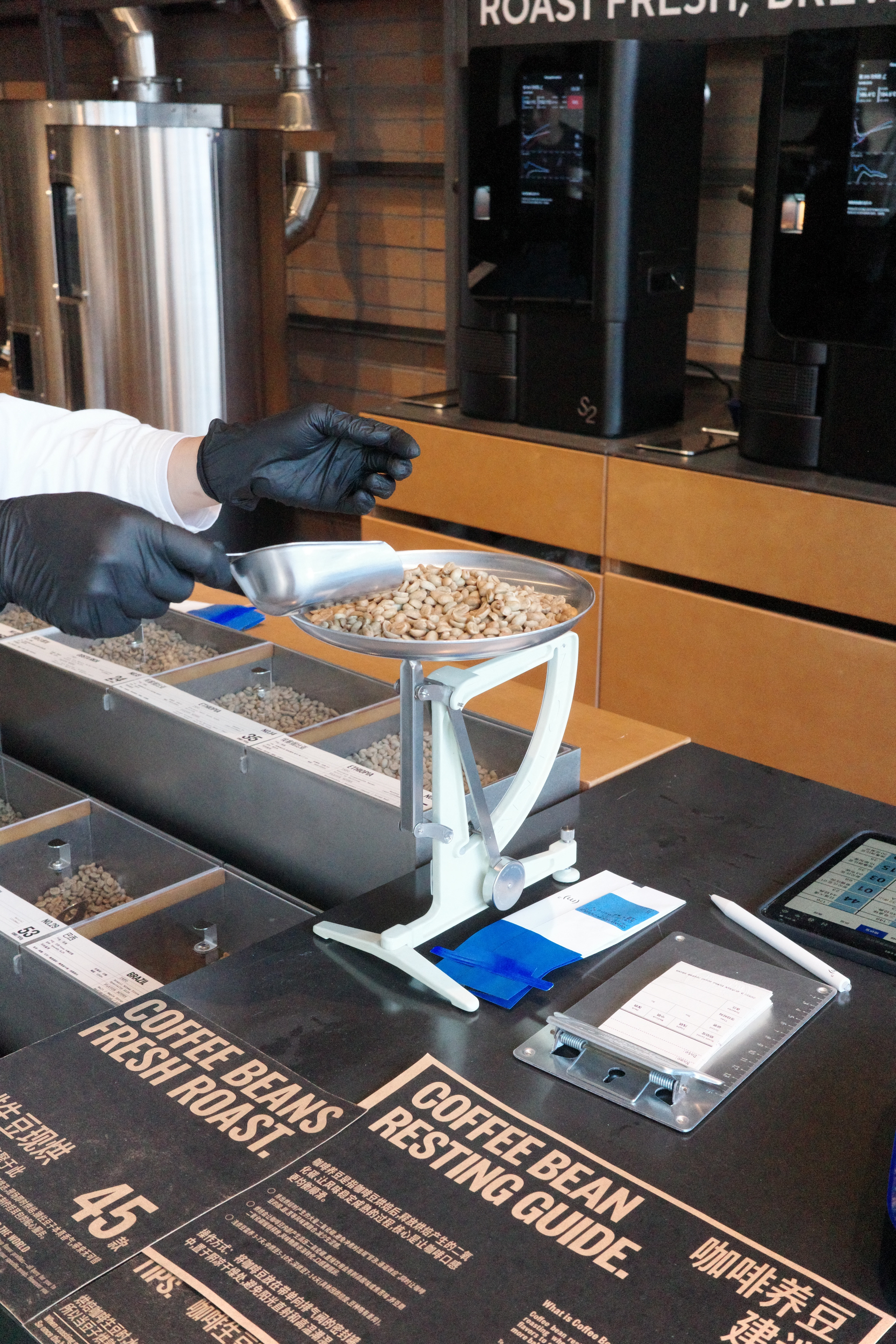
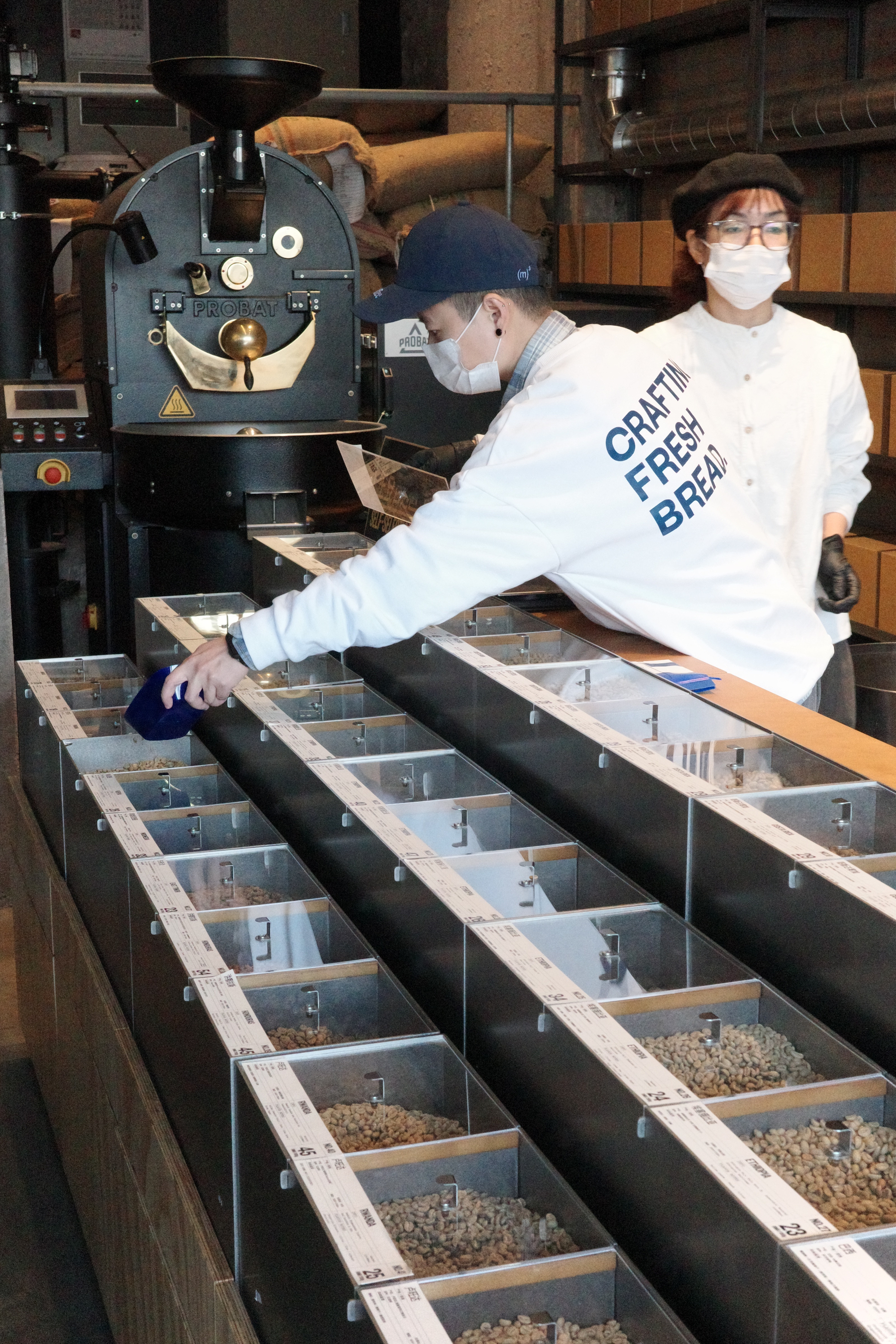
CUBIC3 Coffee 三立方咖啡 — Shanghai, China
there’s so many coffee chains in shanghai! most notably, i see Manner Coffee and Luckin Coffee literally everywhere, but i honestly haven’t tried them yet. coffee hasn’t been my drink of choice lately, which sucks because i created this coffee category for it. i’ve come to realize that i should still take pictures of cute cafes, but not necessarily review the food/drink if unneeded. it’s likely that these cafes won’t be here in a few years anyways or that the quality of beans and whatnot change quickly.
all that being said, i found a spot in shanghai i couldn’t resist trying out: CUBIC3 Coffee (三立方咖啡 locally)! this particular shop was the 兆丰广场店 location.
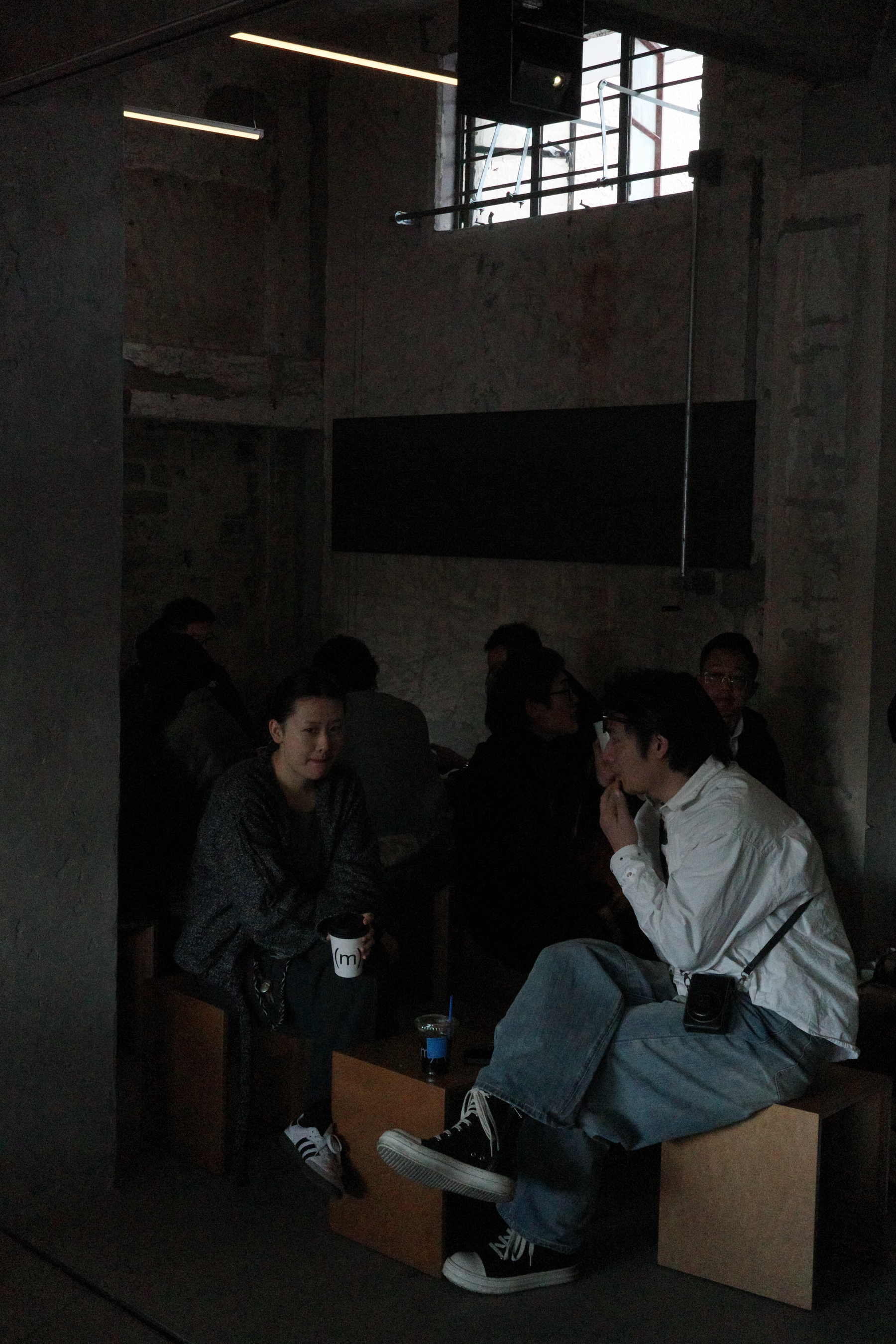
how’s the coffee you might ask? well, no oat milk, so cannot compare to my usual. it was honestly fine, nothing to write home about; just a solid iced latte. the architecture, though, was really pretty. i enjoyed the minimalist x brutalist design with the spaciousness within. it’s also super cool that you can roast your own mix of coffee beans from all around the world! overall, would come back to it! esp. to just relax. it’s right next to a park!!!!






what a cool little house in the marina district! are those solar panels on the sides?? that’s such an interesting placement. curious what the efficiency loss is compared to a traditional roof placement. they are solar panels… right?




at the very least… vote for your best interests. even better, just vote for your best self-interests. but please be informed. it seriously seriously sucks that disinformation and misinformation is constantly rampant. intentional work to dissuade the masses from voting for their self-interests is such a cruel reality. and it’s really just going to get so much worse with AI. so, so, so much worse i’d imagine. while AI has the potential the better inform individuals by allowing for the digestion of technical and legal documents, its ability to create propaganda and fake media indiscernible from reality is terrifyingly unprecendented and genuine existential threat to an informed democracy. i used to view the future as a place of hope, unity, humanitarian advancement, and limitless potential. now, i fear that perspective is simply considered childish naivety… isn’t that just such a shame?
completely political: wtf was that shutdown for? absolutely nothing. wait correction, Americans are set to lose ACA subsidies while politicians have secured a wider net of immunity. actually heinous how little the leaders of our country care about its citizens. don’t get caught in democrats vs republicans. for policies and integrity. assess the track records. we really need a government for the people, not this government for the establishment and elites. all in all, it’s a disappointing state of affairs in our nation. but which representative with power actually cares about my sentiment? especially from a child of immigrants, a former recipient of food stamps, a person of color, and even worse, a young voter? far and few. heinous.
two things on my mind during this subway back home from work:
- i really need to catch up on trip recaps + photos of istanbul, yokohama, and seattle
- i want to make cookies sometime soon, and ppl say this recipe is golden Sally’s Brown Butter Chocolate Chip Cookies Recipe
thank you for listening to my L talk ☺️
さよなら student loans
okay, after much consideration, i’ve decided to just fully pay off my student loans. despite some tax benefits, low borrowing costs, federal borrower protections, and the opportunity cost of capital, the headspace and attention overhead needed for such minor advantages just didn’t make sense anymore.
my financial motto (for now): simple, adequate, and automated.
we love Ws.
just made blog #3 haha -> one for the thoughts and musings that feel a little too intimate
i’ll share with you if you care to ask! it’d be nice to think someone reads the words i put out, although i really shared with a small small handful that likely check maybe once a year! which, for the record, i don’t mind as it’s just a lil place for me to write n keep memories
weird. slept essentially 8 or so hours on a plane. woke up with an hour left in the flight. looked at my watch. watch is gone. panic. then found watch, strap partially detached, slipped into the top of my backpack? huh? not even gonna ask questions atp. what a relief. also dreamed of a super loose tooth, woke up from that and was also relieved that the tooth was in fact not loose. anyways, will i make my 1 hour 20 min connection? likely not since i have a checked bag i need to pick up and recheck 😭 why does hnd-ord have to be weight-restricted so often 🥀
minato coffee — Yokohama, Japan
very small and cute coffee shop! really shows what can be done even with a walk-in closet of a shop. serves coffee jelly, ice cream, espresso soda, and a bit more. lots of beans to choose from + the workers seemed quite cheerful and friendly. for some novelty (and because i wasn’t feel TOO coffee), i strayed from my typical ice oat milk latte and got an iced honey regular milk latte! it was very caramel-ly and i wished i had stuck with my regular order haha, but i know a bunch of people who would’ve enjoyed that drink. what made this a more special experience was that both my parents were there to enjoy it with me, and my mom said the coffee jelly was really good! (she does like to exaggerate things a bit though imo, so take it with a grain of salt!)




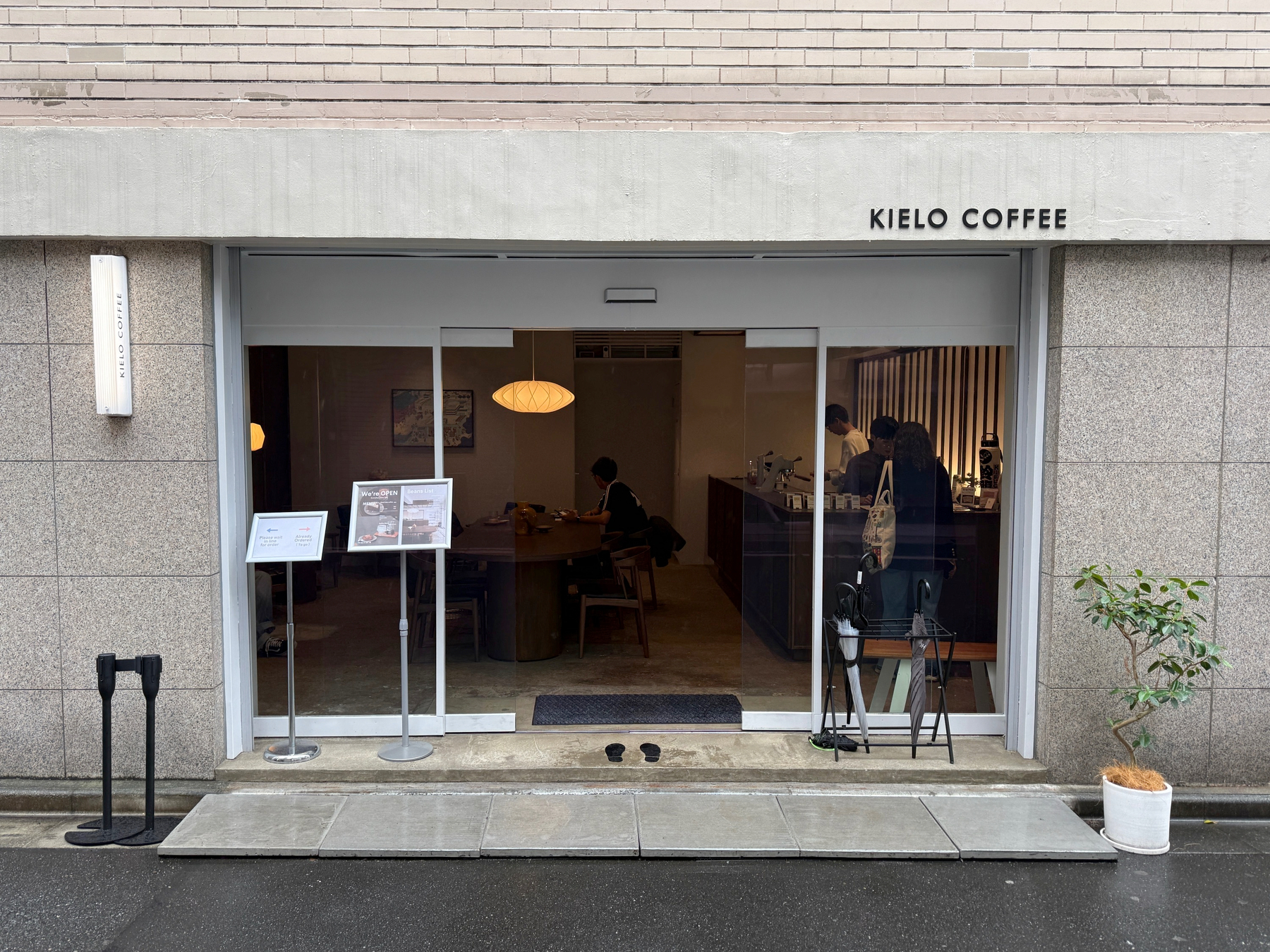
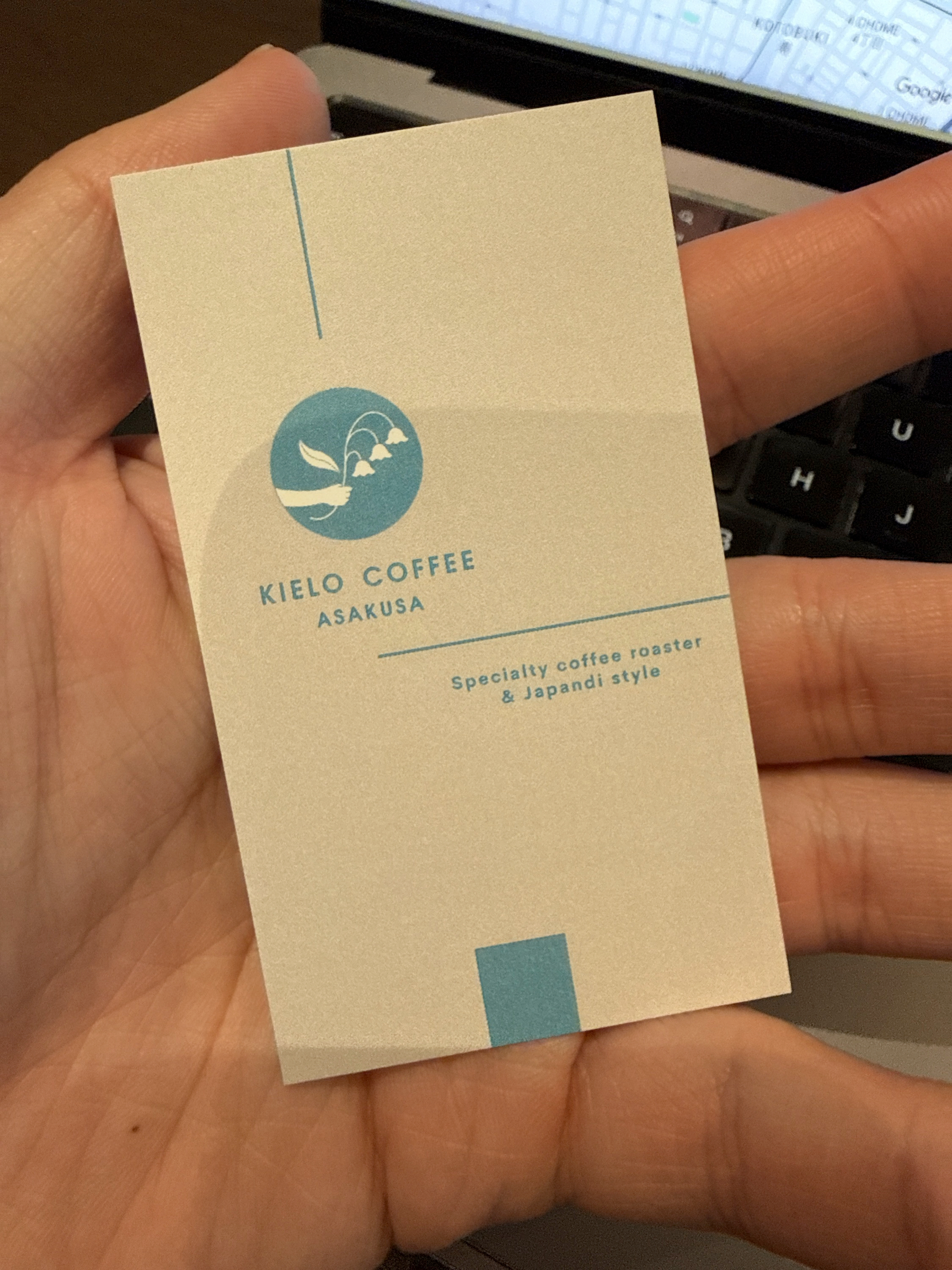
KIELO COFFEE Asakusa — Tokyo, Japan
this is one of three stores that kielo coffee has! the main store has over 1,000 reviews and still sits at 4.7 stars! was a cute little space, not too much seating, had a bit of a wait (likely because where the asakusa store was situated is high traffic, low specialty coffee presence). a strong amount of tourists as well.
i thought the presentation was very cute, and there were a lot of interesting beans to choose from + some pastries! some of the beans can be sold out just fyi, and they have a little setup where you can smell each bean before choosing. the price was a bit shocking for japan imo, ranging from $5 to $12 for a cup of coffee. i liked that they had a little bean profile card that accompanied your drink. i definitely will say that i could taste unique notes in my coffee, although they weren’t to my preference. but overall, good experience! the staff were outgoing and sweet. the presentation, esp. outside of my simple order, was pleasant. i think my order simply didn’t allow for the full experience of the specialty beans as it is an iced latte at the end of the day :)



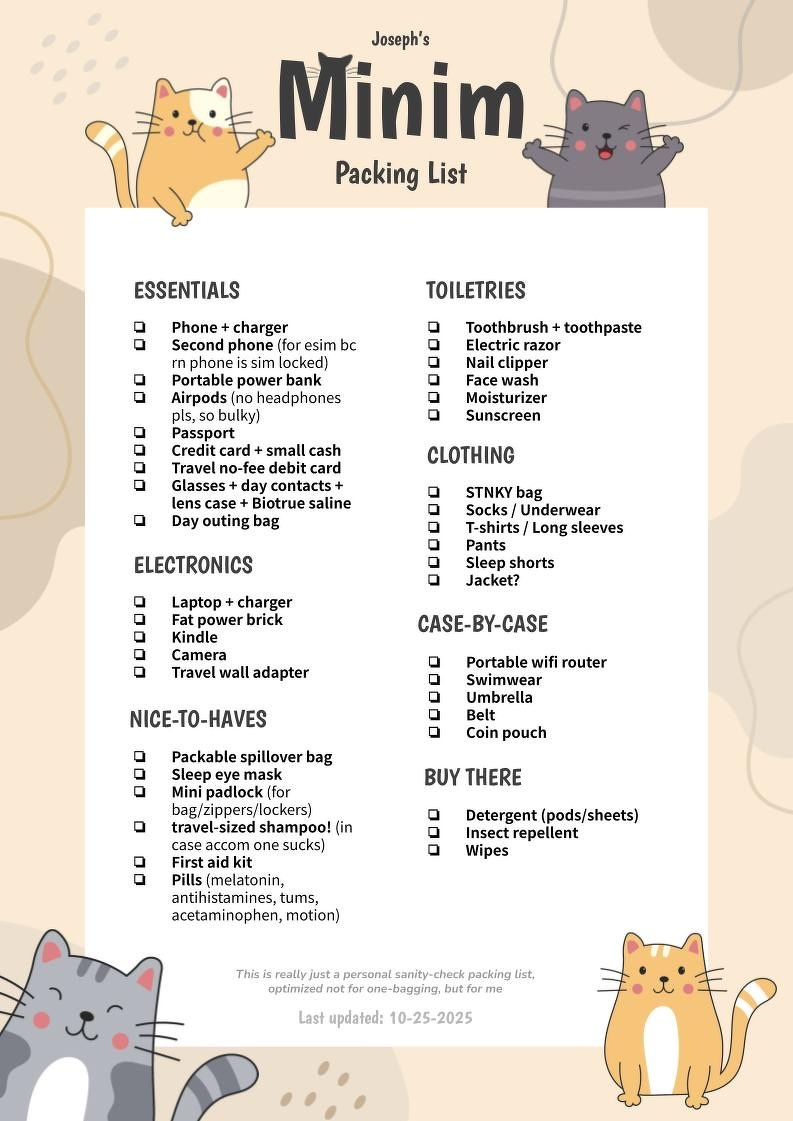
my sanity-check packing list!!!
feel free to see the most updated version here: google slides
really brought on bc i felt like i overpacked a bit for this recent trip to japan, which wasn’t completely in my control… but yeah, didn’t really need the portable wifi router/extender (it’s really cool though), winter jacket killed like at least 25% of my carry-on space (i needed it) , headphones was really unnecessary after I replaced my stolen airpods, two laptops (work & personal) was HEAVY (what can you do? i like having my laptop), kindle… was not really used (T.T) i guess i don’t really need it unless i’m without my laptop?? pick one type of deal?, oh yes and my travel book w/ all the currencies and cards… yeah no, im just gonna pack a travel wallet for those…
anyways, yay! one personal project checked off my list :D